The Moving Universe
Posted by Warren Wong on Wednesday, November 10, 2010
Under: the moving universe

- The Earth is moving relative to everything else in the universe

Everything on your journey to the beginning of the universe is moving relative to everything else in the universe

- The Earth rotates on its axis
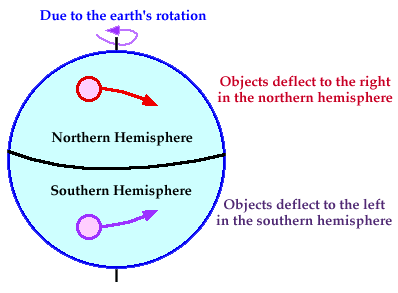
Staring upward at the night sky above you at first get the notion you're stationary in the universe, but nothing could be further from the truth. The Earth beneath you is spinning on its axis at 1000 km/hr, orbiting Sol at 100,000 km/hr, the Milky Way Galaxy at 800,000 km/hr, while the solar system is moving relative to the local stars at 70,000 km/hr. In fact, the universe around us could be moving through a relative space and time of some unknown kind unimaginable to the human consciousness, and we would have no way of detecting this relative motion. We are all travelers in a sense on spaceshipearth1, 1 for the only habitable planet we know of for humankind that exists in the universe.
Everything appears to be moving relative to everything else we view as we look outward into space and time, which makes traveling through space and time a hazardous activity at the best of times. The universe you'll experience on your journey to the beginning of the universe isn't the universe you experience on Earth. The relative motions of everything in the universe means we'll need to explain a few things to you about the way things work in the universe. In future articles we'll talk about the Earth's rotation and orbit around Sol, and how this affects the planet, we'll explain the Earth's motion in the Milky Way Galaxy, and the motion of our solar system in relation to the nearby stars in the night sky. This will give you a base upon which to stand as we take you further out into the cosmos to explain the relative universe you'll experience during your journey. Toward this goal we'll explain the meaning of Einstein's General and Special Relativity for your trip and the way you'll experience things during your journey.
In : the moving universe