Dance Across the Night Sky with Cassiopeia the Queen
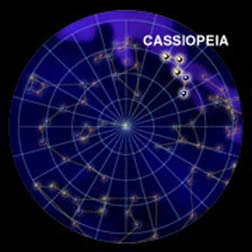
- This star map gives you an idea of the stars in and around Cassiopeia the Queen. NASA photos.
Cassiopeia the Queen is one of the first northern deep sky objects we'll view during our journey to the beginning of the universe. Cassiopeia the Queen is easily recognizable in autumn's night sky using her characteristic W or M shape form and she was one of the 48 constellations originally listed by the 2nd century Greek astronomer Ptolemy during his observations of the night sky. Today, Cassiopeia the Queen is one of 88 constellations recognized by modern star gazers in the night sky, and the abundance of magnificent open star clusters within her arms provides viewers with a chance to see a variety of outstanding celestial objects that have been entertaining star gazers for thousands of years.
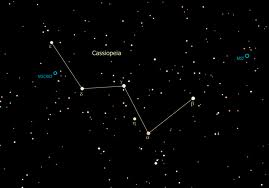
- Five stars outline Cassiopeia's characteristic W shape
Cassiopeia the Queen is a familiar sight for modern astronomers and star gazers in the mid-northern latitudes of planet Earth, and is often one of the first constellations in the northern sky beginning star gazers journey to view. Board your time-machine-to-the-stars near the end of October, or the beginning of November, and take the family on a journey through time and space to visit Cassiopeia the Queen. A visit with Cassiopeia the Queen will open a child's mind to the possibilities of the universe, before them, and your wife will be able to tell her friends that you took her out last night.
- 8x50 astronomical binoculars will reveal about 12 stars nestled in among the collective glow of other stars to faint to resolve
One of the best open star clusters you can view with the naked eye is 6.5 magnitude NGC 129, a large, bright, open cluster of stars 8x50 astronomical binoculars will reveal to have six to twelve brighter stars nestled within the collective glow of a field of stars to faint to resolve using binoculars. You should see about 35 celestial bodies in this region of space and time 5,200 light years distant from your position on the Earth. Look toward the north of two 9th magnitude stars, near the center of NGC 129, and you'll find the Cepheid variable DL Cassiopeiae. DL Cassiopeiae will fluctuate between 8.6 and 9.3 magnitude, over the course of an eight-day cycle.
The central star in Cassiopeia's characteristic W is Gamma Cassiopeiae, a prototype for a class of irregular variable stars believed to be rapidly spinning type-B celestial bodies often fluctuating by as much as magnitude 1.5 or more, Gamma Cassiopeiae will flicker between 2.2 and 3.4 magnitude as you watch her nightly dance and this star at maximum brightness outshines both Alpha Cassiopeiae and Beta Cassiopeiae. Astronomers believe these apparent fluctuations are due to a decretion disc around this star resulting from the rapid spinning of the star, which results in some of the star's mass forming a decretion disc. Gamma Cassiopeiae is also a spectroscopic binary star with an orbital period of about 204 days and astronomers believe Gamma Cassiopeiae's companion star is about the same relative mass as Sol. Part of a small group of stellar sources in the night sky that beam of X-ray radiation about 10 times higher than the X-rays emitted from other type-B stars across the cosmos, Gamma Cassiopeiae exhibits both short-term and long-term cycles of x-ray emission. Star gazers should also be able to view Gamma Cassiopeiae as an optical double star, with a faint magnitude 11 companion star, about 2 arc seconds distant from Gamma Cassiopeiae.
Ancient star gazers in China called Gamma Cassiopeiae Tsih, which loosely translates as "the whip", but no references have been found in Arabic or Latin texts of Gamma Cassiopeiae being referred too using a different name. Modern star gazers refer to Gamma Cassiopeiae by a number of different designations, including 27 Cassiopeiae, HR 264, HD 5394, and others. Modern astronauts often use Gamma Cassiopeiae as a star-guide because it's a relatively bright celestial object and in previous space missions this star was used as an easily recognizable navigational reference point in the night sky.

- M103 (NGC 581) will reveal about 25 magnitude 10 or fainter stars
M103 (NGC 581) is the first of two Messier objects in Cassiopeia's arms viewable through a six-inch time-machine-to-the-stars and should appear as about three dozen stars grouped in a triangular area 6' across. A fairly compact open cluster, M103 will be 1 degree east of Delta Cassiopeiae, and is the left bottom star of Cassiopeia's characteristic W shape marking her throne in the night sky. Pierre Mechain was first given credit for seeing this open cluster in the night sky in 1781. Star gazers using 8x50 binoculars will see about 25 magnitude 10 or fainter stars in their view and a string of four stars immediately to M103's southeast, which adds to the beauty of viewing M103, significantly.
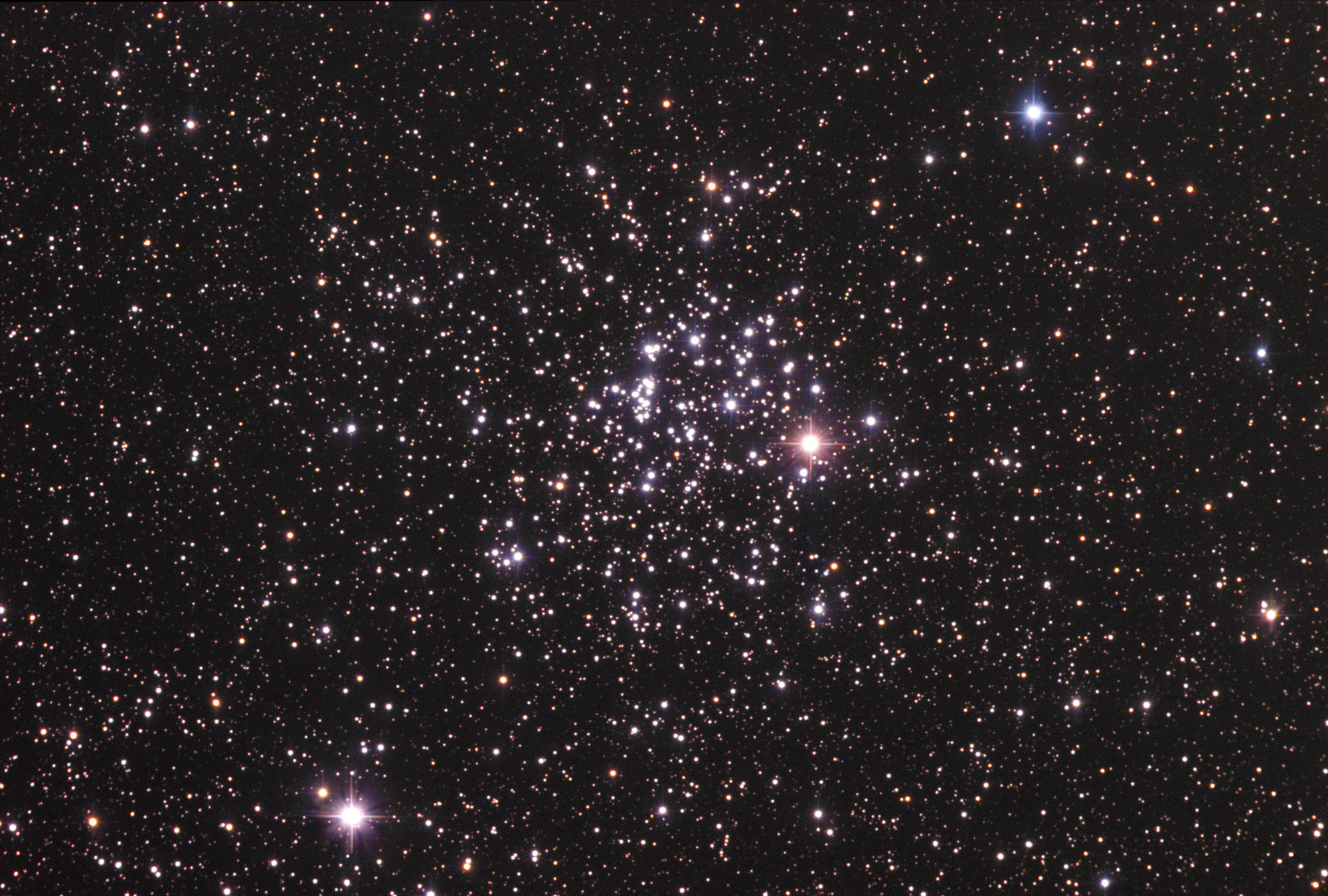
- M 52 (NGC7654) is one of the richest open clusters to view north of the celestial equator
The second Messier object in Cassiopeia catalogued by Messier is M52 (NGC 7654), you can locate M52 by drawing a line from Alpha Cassiopeiae through Beta Cassiopeiae, and then extending your line an equal distance to M52. An 8-inch time-machine-to-the-stars will reveal about 75 stars in the night sky clumped in various patterns along the edge of the Milky Way that aren't lost among the background points of light behind these stars. One of the richest open clusters in Cassiopeia's arms and north of the celestial equator, Messier made note of M52 in his catalogue in 1774. This open cluster will appear as a nebulous mass of about 100 stars in 8x50 astronomical binoculars, with a few individual stars that you can resolve a little better. Star gazers looking for a little extra should look to the north of M52 to find Harrington 12, a wide triangular looking asterism containing about a dozen 5th to 9th magnitude stars, which will appear spectacular in low-power astronomical binoculars.
Journey less than 3 degrees south of Delta Cassiopeiae to find the spectacular Owl Cluster (NGC 457), a celestial object ancient star gazers could plainly see in the north night sky, the Owl Cluster's wings will be clearly viewable using a 4-inch time-machine-to-the-stars. Star gazers can also locate Delta Cassiopeiae by using 5th magnitude Phi Cassiopeiae and 7th magnitude HD 7902, which lie to the southeast of the Owl Cluster. The Own's eastern wing is a line of four bright stars, while the western wing is composed of two pairs of stars arranged in a long rectangle. The brightest star in the Owl Cluster will shine at 8.6 magnitude and will appear a little orange in color in star gazers.

In : Star Astronomy