Journey into the Heart of the Beehive
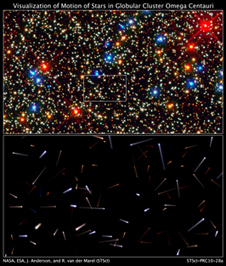
- The bottom photo reminds many of bees moving around in a hive. NASA photos
The Hubble Space Telescope takes the human journey to the beginning of the universe into the beehive

- The view from the Hubble Space Telescope
The Hubble Space Telescope's vision is so sharp astronomers have used the images they have collected over a four-year period of viewing globular cluster Omega Centauri to precisely measure the relative motions of over 100,000 individual stars in the beehive. In an effort to gain insight into the evolution and life cycle of tight groups of stars formed in the early universe, and try to determine if there's in fact an intermediate mass black hole hidden in the beehive. This study was conducted over a four-year period by Jay Anderson and Roeland van der Marel of the Space Telescope Science Institute using Hubble's Advanced Camera for Surveys and high-speed, sophisticated computer programs to measure the relative motions of individual stars in the beehive.On a clear night in the southern equatorial region of the night sky it's even possible to view the 3.5 magnitude beehive with the naked eye. Globular cluster Omega Centauri will appear as a fuzzy star that early astronomers believed was a single star. Use astronomical binoculars as your time-machine-to-the-stars, or a telescope, and the view becomes a wonder to behold as wide across in your view finder as the Full Moon. Using an 8-inch time-machine-to-the-stars you'll view about 1,000 stars, each a faint pinprick of light, and you should notice that the beehive isn't completely circular. Globular cluster Omega Centauri in fact rotates at a pretty fast speed around its central gravitational mass and astronomers believe this is one reason it's less than circular
In : Star Astronomy