You Think Life on Earth is Tough!

- Journey to this system to see what life would be like

Take a journey to the beginning of the universe and view exo-planets that might be more like death-planets for humans

- You might find life to be a little harder here

Planets circling twin stars close in proximity could be a real tough place for life to begin, according to the conclusions of a study conducted using data from NASA's Spitzer Space Telescope. Space scientists using NASA's infrared observatory recently found what they believe to be clouds of possible dust around three mature, close orbiting binary stars. Dust that scientists think is possibly the result of the planets orbiting these twin stars colliding, which could make living on these planets difficult for any lifeforms that might have arisen on these planets.
Planetary collisions are possible real-life science fiction in action, as the reasons for the dust clouds are certainly a matter of conjecture, and something that any science fiction writer is going to be able to spin a tale of annihilation around. Lifeforms evolving under the environmental conditions that possibly exist on planets orbiting binary stars of the particular class studied would certainly be something beyond the imagination of any human writer. It's unlikely that anything we humans create using our imaginations could ever match the possibilities that exist in space and time. The finite imaginations of humans is limited by our senses, experiences and of course the limits of what we refer to as our human perception or intelligence to some.
Lifeforms evolving on these planets would have to survive possible planetary collisions at regular intervals, if space scientists conclusions are correct? If they have the ability to sense the world beyond their normal lives? Lifeforms existing on these planets could be non-sentient and unable to perceive the annihilation above them. They could be looking up at annihilation coming toward them in the form of another planets, asteroid, or other celestial body orbiting the binary star systems in question. They may have been destroyed in a recent collision between planets and are space dust, once again. The view would be a spectacular one though, with two huge suns that would exceed anything we experienced viewing the double stars systems in the Star Wars Saga.
Life evolving on planets circling binary stars like the ones in question would have a limited time to evolve into a space traveling sentient race as well. The suns in the binary star system they have evolved on are slowly circling closer and closer, according to astronomers, which could possibly make surviving and evolving on these planets a lot more difficult. Lifeforms surviving and thriving on these planets would likely be a survivor beyond human imagination, so we should probably thank our lucky stars that they aren't likely to be stopping by for a visit, anytime soon.
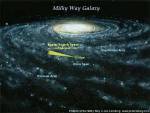
- We have a lot of places to look for new planets suitable for human life. Guess we better get started.

In : exo-planets